
Nutrition
What Are the Best Summer Fruits and Vegetables for Growing Kids?
Why summer is the best time of year to build a lifelong love of fresh produce in your child
Jai-Lin Garrett (Coach Jai), CNC, CWC | Children of America’s Nutritionist
I think we can all agree that cold, freshly cut watermelon or strawberries bought from one of those pop-up farmers stalls just hit different in the summer. Summer without our favorites will always feel like something is missing at the Fourth of July barbecue or the pool day with the family. And I would argue it is more than just a social thing we do, like popcorn at the movie theater. There is real nutritional truth behind why these fruits taste so extraordinary this time of year and why we all crave them, especially our children who are soaking up every bit of heat and fun before summer ends. Let me tell you what is actually behind that craving.
1. Why Summer Produce Hits Different
Of all the seasons, summer is the season of cold, refreshing, hydrating produce that is the foundation of a memorable few months. And there is a reason the produce tastes better right now than it does any other time of year. Just like we talked about with spring eating, summer fruits and vegetables are at their biological peak during these months. They have had the ideal combination of heat, sunlight, and soil conditions to grow into the most flavorful, most pigmented, most nutrient-dense versions of themselves. When you buy a strawberry from a local summer stand versus a grocery store in January, you are not buying the same food. The summer version is juicier, deeper in color, richer in vitamins, and noticeably sweeter because the plant had exactly what it needed to thrive. For young children, this matters in a very practical way. Children’s palates are forming right now, and the impressions food makes on them at this age shape what they reach for as they grow. A child who tastes a peak-season summer peach or a sun-warmed cherry tomato straight from the vine is having a completely different experience than a child offered watery out-of-season produce in the middle of winter. Summer is genuinely one of the best windows you have to build a love of real food in your child, because the food itself is doing most of the convincing.
2. The Best Summer Fruits for Growing Kids
Watermelon
Watermelon is the undisputed star of summer for good reason. It is about 92 percent water, making it one of the most hydrating foods available, and it delivers potassium, magnesium, vitamins A and C, and lycopene, a powerful antioxidant that gives it its deep red color and supports cellular health. For a growing child who is sweating through active summer days, watermelon is replenishing fluids and electrolytes at the same time. The practical tip here is worth its own mention: buy a whole melon, spend thirty minutes breaking it down into cubes, and store it in containers in the fridge. One melon can last a week and becomes the go-to hydrating snack for everyone in the house. Cold, ready, and within reach. That is the whole strategy.
Oranges and Clementines
Oranges and clementines deserve the same enthusiasm as watermelon for all of the same reasons: high water content, natural electrolytes, vitamin C, fiber, and folate that supports healthy cell growth and development. But there is an extra dimension here that parents of toddlers will appreciate. Peeling an orange or pulling apart a clementine is a genuine sensory and fine motor activity for little hands that are still developing dexterity. That tactile engagement with food, the texture, the smell, the small motor work of separating the segments, is building more than just nutrition. It is building a positive and curious relationship with real food.
Clementines are also one of the easiest whole fruits to throw into a bag for a beach trip, a park visit, or a pool day. No cutting required, naturally portioned, and children love them.
Strawberries
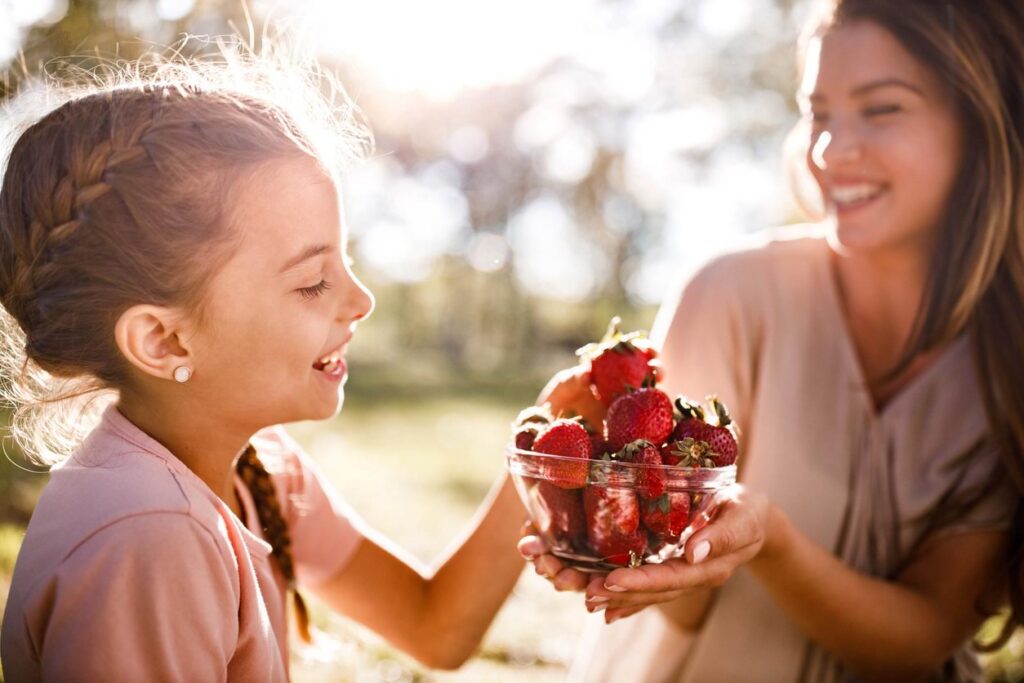
Strawberries in summer are a completely different food from the strawberries sitting in a plastic clamshell at the grocery store in February. In season, especially sourced locally from a stand or a farmers market, they are bigger, juicier, more fragrant, and meaningfully more nutrient-dense.
Peak-season strawberries are an excellent source of vitamin C, manganese, folate, and fiber, and their natural sweetness in summer makes them one of the easiest fruits to put in front of a child who is still learning to love whole foods. If you have access to a pick-your-own strawberry farm near you in early summer, take your child. The experience of picking their own food is one of the most powerful introductions to whole produce that exists for a young child.
Peaches and Nectarines
If there is one fruit that feels like summer in a single bite, it is a ripe peach. Peaches and nectarines are at their absolute best from June through August, and the difference between a peak-season peach from a local stand and a rock-hard grocery store version in March is not even a comparison worth making. In season, they are soft, fragrant, naturally sweet, and loaded with vitamins A and C, potassium, and fiber. For young children, the soft texture of a ripe peach makes it one of the easier stone fruits to eat, and the sweetness needs no convincing. Slice them into wedges, remove the pit, and serve cold. Nectarines are essentially the same fruit without the fuzz, which some children actually prefer. Either way, if you see them at a local stand or farmers market this summer, grab them.
Kiwi
Kiwi is one of the most nutrient-dense fruits per serving available, delivering more vitamin C than an orange, plus vitamin K, folate, potassium, and fiber in a small, bright green package. The visual appeal alone makes it interesting to young children. Slice it into rounds, scoop the flesh
out with a spoon, or let an older toddler try both approaches. The slight tartness paired with natural sweetness makes it a fruit that wakes up the palate in a way that milder fruits do not.
Pineapple
Fresh pineapple in summer is another fruit that earns its place on this list for both nutritional and sensory reasons. It is rich in vitamin C, manganese, and bromelain, a naturally occurring enzyme that supports digestion and has anti-inflammatory properties. For children, the bright yellow color, the distinctive tropical sweetness, and the texture make it genuinely exciting. Serve it cold in cubes or alongside other fruits in a summer fruit bowl. Fresh pineapple is significantly more nutritious than canned, which often comes packed in syrup and has lost much of its enzyme content through heat processing.
3. The Best Summer Vegetables for Growing Kids
Cucumbers
Cucumbers are approximately 95 percent water, which makes them one of the most hydrating vegetables you can offer a child on a hot summer day. They are mild in flavor, satisfying to crunch, and require almost no prep. Slice them into rounds or sticks, keep them cold in the fridge, and pair them with hummus for a snack that adds plant-based protein and healthy fat alongside the hydration. For toddlers, the crunch and the cool temperature make cucumbers genuinely appealing without any convincing required.
Bell Peppers
Raw bell peppers, especially the red, orange, and yellow varieties, are one of the most nutrient-dense vegetables you can put in front of a young child in summer. Red bell peppers in particular contain more vitamin C than an orange, alongside vitamin A, vitamin B6, folate, and fiber. They are naturally sweet when raw, which makes them far more palatable to young children than many other vegetables. Slice them into strips and serve cold alongside hummus, guacamole, or a yogurt-based dip. The bright colors also make them visually exciting for children who are drawn to colorful food.
Cherry Tomatoes
Cherry tomatoes are at their peak sweetness in summer and are one of the most child-friendly vegetables available this season. They are rich in lycopene, vitamin C, potassium, and folate. For toddlers, always halve them to make them safe and easy to eat. Older preschoolers can bite into
them whole. Their pop of sweetness makes them feel more like a snack than a vegetable to most children, and serving them cold straight from the fridge adds to the appeal on a hot day.
Zucchini
Zucchini is one of the most versatile and approachable summer vegetables for young children. It is mild in flavor, high in water content, and rich in vitamins A and C, potassium, and fiber. Sliced raw into rounds it works as a dipper. Roasted in small cubes it becomes soft and slightly sweet in a way that toddlers tend to enjoy. Grated into scrambled eggs, muffins, or pasta sauce it becomes virtually invisible, making it one of the easiest ways to add vegetable nutrition to meals without any negotiation.
Edamame
Edamame is a summer staple that children tend to love without much encouragement, and it is one of the most nutritionally complete snack vegetables available this season. It delivers plant-based protein, fiber, iron, and calcium in one small serving, which makes it genuinely useful for active summer days when children need sustained fuel. Serve it warm and lightly salted straight from the pod and let your child pop the beans out themselves. It is the kind of interactive snacking experience that keeps little hands and mouths happily occupied, and the mild, slightly sweet flavor makes it one of the more universally accepted vegetables among young children.
4. How to Actually Get Kids to Eat Summer Produce
Make it the only option, and make it completely normal. That sounds simple, and it is. When you pack the cooler for a pool day or a park trip with cold watermelon cubes, clementines, cucumber slices, and bell pepper strips, and that is what is available, children eat it. Not because you convinced them or negotiated with them, but because they are hot, they are hungry, they have been running and sweating, and cold fresh fruit is exactly what their body is asking for. You do not need to sell it. You just need to have it there.
I promise that a child who has spent the day in the summer sun will be far more grateful for cold watermelon from the cooler than a fruit pouch that does not come close to refreshing them the same way. Real fruit actually hydrates. It fills them up. It satisfies both their hunger and their
body’s need for fluid and minerals. A few bites of a processed snack does neither of those things. The body knows the difference, even when the child does not yet have the words for it. At home, the same principle applies. Keep cut fruit and washed vegetables at eye level in the fridge, cold and ready to grab. When children open the fridge and the first thing they see is a container of cold watermelon cubes or sliced strawberries, they reach for it. No prompting needed. You set the environment. They do the rest.
5. The Summer Produce Mindset: Variety and Color Are Your Best Friends
Variety and color are your best tools during the summer with produce. With your child spending their days in the sun, burning more energy than usual, and getting tired faster than a typical school day, the best way to fill up their seemingly endless appetite is to have as many options of
fresh produce available as possible. Rotate through the summer season staples consistently so your child is getting a wide range of nutrients, natural electrolytes, and hydration from different sources. The more colors on the plate, the broader the nutritional coverage, and the more interesting the experience for a child who is still learning what they love. The summer season is short. The produce that is available right now is at its best right now. Take advantage of it while it is here, let your child eat freely and often, and trust that a child who is filling up on cold seasonal fruit and vegetables is doing something genuinely wonderful for their growing body.
How Children of America Celebrates Summer Produce Every Day
At Children of America, summer is one of the most active and nourishing seasons of the year through Summer Camp WOW. The Apple A Day Nutrition Program ensures that CACFP-aligned meals and snacks reflect the season, with fresh produce incorporated as a regular and celebrated part of what children eat throughout the day. Family-style dining gives children the opportunity to explore new fruits and vegetables at their own pace in a relaxed and social setting, which mirrors the low-pressure approach that makes summer the best season for expanding a young child’s palate. COA’s Mind & Body Matters philosophy recognizes that nourishing growing bodies with real, seasonal food is part of the whole-child commitment that guides everything we do.
Variety and color. Two words that will carry you through the whole summer. Have as many options available as possible, rotate through the best of what the season has to offer, and let your child’s body guide the rest. If you have questions about building a summer nutrition routine for your child or want to talk through what to stock and what to skip, I am here for it. Reach out to me directly at jgarrett@childrenofamerica.com. To learn more about the meals, programs, and Summer Camp WOW at a Children of America near you, use the Find A School button at the
top of our website.
References
1. USDA Agricultural Research Service. (2022). FoodData Central: Seasonal produce
nutrient data. https://fdc.nal.usda.gov
2. Rickman, J.C., Barrett, D.M., & Bruhn, C.M. (2007). Nutritional comparison of fresh,
frozen, and canned fruits and vegetables. Journal of the Science of Food and Agriculture,
87(6), 930-944. https://doi.org/10.1002/jsfa.2824
3. American Academy of Pediatrics. (2023). Serving Sizes for Toddlers.
https://www.healthychildren.org
4. Produce for Better Health Foundation. (2020). State of the Plate: America’s Fruit and
Vegetable Consumption Trends. https://fruitsandveggies.org
5. Mennella, J.A., & Trabulsi, J.C. (2012). Complementary foods and flavor experiences:
setting the foundation. Annals of Nutrition and Metabolism, 60(2), 40-50.
https://doi.org/10.1159/000335337
6. Wardle, J., Cooke, L.J., Gibson, E.L., Sapochnik, M., Sheiham, A., & Lawson, M. (2003).
Increasing children’s acceptance of vegetables; a randomized trial of parent-led
exposure. Appetite, 40(2), 155-162. https://doi.org/10.1016/S0195-6663(02)00135-6
7. USDA. (2020). Dietary Guidelines for Americans, 2020-2025.
https://www.dietaryguidelines.gov
